- Published on
Dua for Iftar — What to Say When Breaking Your Fast
- Authors

- Name
- Sih C.
- Role
- Founder & Islamic Content Researcher • Islamful
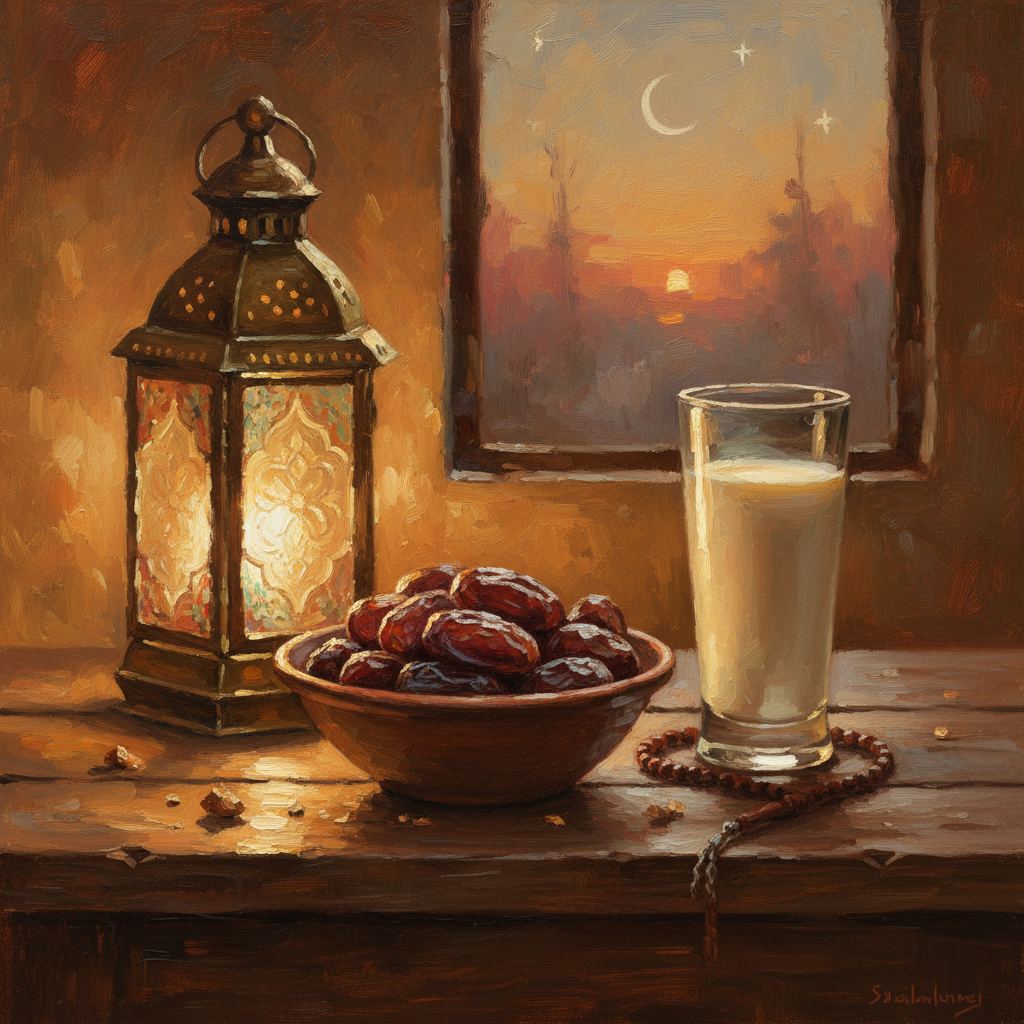
Iftar is one of the most anticipated moments of the Muslim day — especially in Ramadan. The adhan for Maghrib sounds, the sun drops below the horizon, and a day of fasting ends. There is a dua the Prophet Muhammad (peace be upon him) taught us to say at precisely this moment. It is short, grounded in the Sunnah, and transforms the act of eating into an act of worship.
The Main Dua for Iftar
The primary dua for iftar is the narration of Abdullah ibn Umar (may Allah be pleased with him). It was reported by Abu Dawud and graded hasan by al-Albani.
Arabic:
ذَهَبَ الظَّمَأُ وَابْتَلَّتِ الْعُرُوقُ وَثَبَتَ الْأَجْرُ إِنْ شَاءَ اللَّهُ
Transliteration:
Dhahaba al-zama'u wabtallatil-'uruqu wa thabata al-ajru in sha Allah
Translation:
"The thirst is gone, the veins are moistened, and the reward is established, if Allah wills."
Source: Narrated by Abu Dawud, 2357. Graded hasan by al-Albani.
This dua is remarkable in its honesty. It acknowledges the physical reality of the body — the thirst that is now gone, the veins that are now replenished — and immediately connects that physical moment to something eternal: the reward with Allah, anchored in hope with the words in sha Allah.
The Second Dua for Iftar
A second narration is also reported in Abu Dawud and is widely recited, particularly in Ramadan.
Arabic:
اللَّهُمَّ لَكَ صُمْتُ وَعَلَى رِزْقِكَ أَفْطَرْتُ
Transliteration:
Allahumma laka sumtu wa 'ala rizqika aftartu
Translation:
"O Allah, for You I fasted, and upon Your provision I break my fast."
Source: Narrated by Abu Dawud, 2358. Graded hasan.
This dua is more explicitly an act of worship — a declaration of sincerity. It names Allah directly, states the fast was for Him alone, and acknowledges that the food being eaten comes from His provision. Both duas are valid and you can recite one or both at iftar time.
أَصْبَحْنَا وَأَصْبَحَ الْمُلْكُ لِلَّهِ، وَالْحَمْدُ لِلَّهِ، لَا إِلَهَ إِلَّا اللَّهُ وَحْدَهُ لَا شَرِيكَ لَهُ، لَهُ الْمُلْكُ وَلَهُ الْحَمْدُ وَهُوَ عَلَى كُلِّ شَيْءٍ قَدِيرٌ
Asbahna wa asbahal-mulku lillah, walhamdu lillah, la ilaha illallahu wahdahu la shareeka lah, lahul-mulku walahul-hamd, wahuwa 'ala kulli shay'in qadeer
We have reached the morning and at this very time all sovereignty belongs to Allah. All praise is for Allah. None has the right to be worshipped except Allah alone, without partner. To Him belongs all sovereignty and praise, and He is over all things omnipotent.
Abu Dawud 4:317
اللَّهُمَّ بِكَ أَصْبَحْنَا، وَبِكَ أَمْسَيْنَا، وَبِكَ نَحْيَا، وَبِكَ نَمُوتُ، وَإِلَيْكَ النُّشُورُ
Allahumma bika asbahna, wa bika amsayna, wa bika nahya, wa bika namootu, wa ilaykan-nushoor
O Allah, by Your leave we have reached the morning and by Your leave we have reached the evening, by Your leave we live and die, and unto You is our resurrection.
At-Tirmidhi 5:466
اللَّهُمَّ إِنِّي أَسْأَلُكَ الْعَافِيَةَ فِي الدُّنْيَا وَالْآخِرَةِ، اللَّهُمَّ إِنِّي أَسْأَلُكَ الْعَفْوَ وَالْعَافِيَةَ فِي دِينِي وَدُنْيَايَ وَأَهْلِي وَمَالِي
Allahumma inni as'alukal-'afiyah fid-dunya wal-akhirah. Allahumma inni as'alukal-'afwa wal-'afiyah fi deeni wa dunyaya wa ahli wa maali
O Allah, I ask You for well-being in this world and the next. O Allah, I ask You for pardon and well-being in my religious and worldly affairs, and my family and my wealth.
Abu Dawud 4:316, Ibn Majah 2:332
The Accepted Dua at Iftar
Iftar is not just the end of hunger — it is one of the most powerful moments for supplication in Islam. The Prophet ﷺ said:
"The fasting person has a supplication that is not rejected when he breaks his fast."
Source: Narrated by Ibn Majah, 1753; al-Tirmidhi, 3598. Graded hasan.
This hadith is the reason why the moment of iftar carries such weight. You are in a special state: you have spent the day fasting sincerely for Allah, and your dua at this moment is among the most likely to be answered.
The practical implication is clear — do not rush past iftar as simply a meal. After reciting the iftar dua, spend a few moments in personal supplication. Ask for what you genuinely need: health, guidance, forgiveness, ease in your affairs, well-being for your family. The window does not last long, so be present and focused.
In a related narration: "Three supplications are not rejected: the supplication of the fasting person when breaking the fast, the supplication of the just ruler, and the supplication of the oppressed." (Narrated by al-Tirmidhi, 3598; Ibn Majah, 1752. Graded hasan.)
When to Say the Iftar Dua
Say it at the exact moment of breaking the fast. This means as you reach for your date, your first sip of water, or your first bite of food. Not halfway through the meal, not after Maghrib prayer — at the transition point itself.
The spirit of the dua is in that precise moment of crossing from fasting to eating. You are acknowledging, in real time, that the fast was for Allah and that the food you now eat is His provision. Saying it later loses that quality.
If you forget and only remember mid-meal, say it then — it is still better than leaving it. Missing it is not a sin and does not affect the validity of your fast, but make it a consistent habit, particularly through Ramadan.
The Sunnah of Breaking Fast with Dates
The iftar dua connects naturally to the sunnah of what to break the fast with. Anas ibn Malik (may Allah be pleased with him) reported:
"The Prophet ﷺ used to break his fast with fresh dates before praying. If there were no fresh dates, he would break it with dried dates. If there were no dried dates, he would take some sips of water."
Source: Narrated by Abu Dawud, 2356. Graded hasan.
The Prophet ﷺ would typically eat an odd number of dates — often three. Dates provide natural sugar that the body absorbs quickly after a day of fasting, giving immediate energy without overwhelming the digestive system. This is one of those sunnah acts that carries both spiritual reward and practical wisdom.
Keep a bowl of dates at your iftar table. Say the dua, take a date, then pray Maghrib — this is the pattern closest to what the Prophet ﷺ did.
Iftar in Ramadan — A Moment of Joy
The Prophet ﷺ described two moments of joy for the fasting person:
"The fasting person has two moments of joy: when he breaks his fast, he rejoices; and when he meets his Lord, he will rejoice over his fasting."
Source: Narrated by al-Bukhari, 1904; Muslim, 1151.
The joy of iftar is not incidental. It is built into the nature of fasting — the hunger and thirst make the relief at Maghrib something the whole body feels. The iftar dua is the way of ensuring that joy is also a conscious act of gratitude, not just a physical response to food.
Ramadan intensifies all of this. The collective nature of Ramadan iftar — families breaking fast together, mosques filling up, the shared rhythm of the ummah — gives the dua a communal dimension. When millions of Muslims say these same words at the same moment around the world, it is something significant.
How to Make the Most of Iftar Dua
Here is a simple structure for the iftar moment:
- Reach for a date or water — hold it in your hand
- Say the dua — "Dhahaba al-zama..." or "Allahumma laka sumtu..." or both
- Make personal supplication — ask for what you need, sincerely and briefly
- Eat and then pray Maghrib
Do not let the rush of iftar — the hunger, the family, the food spread — crowd out the dua. It takes five to ten seconds. The reward, if Allah wills, is lasting.
Free Islamic Tools
See all →Related Duas and Resources
The iftar dua is one part of a broader set of supplications connected to fasting in Islam.
- Dua for Breaking Fast — a detailed look at both main iftar duas, their hadith chains, and variations
- Dua for Fasting — covers the niyyah (intention) before suhoor, during-fast adhkar, and the iftar dua
- Dua for Opening Fast — specifically the niyyah and opening supplications said before starting the fast
- Dua for Laylatul Qadr — the special dua for the Night of Decree: "Allahumma innaka 'afuwwun tuhibbul 'afwa fa'fu 'anni"
- Prayer Times — know your exact Maghrib time so you break the fast at the right moment
To browse the full collection of daily and occasional duas, visit the Dua Collection on Islamful — organized by occasion with Arabic text, transliteration, and meaning.
Wallahu a'lam — والله أعلم — Allah knows best.
Frequently Asked Questions
What is the dua for iftar?
The main dua for iftar is: 'Dhahaba al-zama'u wabtallatil-'uruqu wa thabata al-ajru in sha Allah' — 'The thirst is gone, the veins are moistened, and the reward is established, if Allah wills.' This is narrated by Abu Dawud (2357) and graded hasan by al-Albani.
When exactly should you say the iftar dua?
Say the dua at the exact moment of breaking the fast — as you reach for your first date, sip of water, or bite of food. Do not wait until after the meal. The spirit of the dua is in the transition itself, moving from fasting to eating while attributing both states to Allah.
Is the fasting person's dua at iftar accepted?
Yes. The Prophet said: 'The fasting person has a supplication that is not rejected when he breaks his fast.' This is narrated by Ibn Majah (1753) and al-Tirmidhi (3598), graded hasan. Immediately after reciting the iftar dua, make your personal supplications — that window is one of the most powerful times for dua.
What should you break the fast with according to the Sunnah?
The Prophet would break his fast with fresh dates. If dates were unavailable, with dried dates. If neither was available, he would drink some water. This is narrated by Abu Dawud (2356) and graded hasan. Breaking with an odd number of dates — typically three — follows his practice.